

Promotion and Expansion of Neonatal Resuscitation Training
Creating a Safe Environment for Childbirth
ASHA is working to promote neonatal resuscitation in order to save the lives of newborns in Nepal.
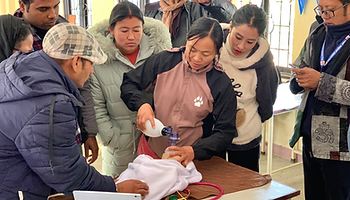
By establishing standardized treatment protocols—including advanced techniques that are not yet widely implemented in Nepal—and providing practical, simulation-based training designed to reflect real clinical settings for local healthcare professionals as well as medical and nursing students, we aim to save as many newborn lives as possible.
We conduct basic health knowledge and first aid education for junior high school students in Nepal. The goal is to enhance health literacy by empowering individuals with knowledge and skills in first aid and home medicine. This enables them to make informed decisions about appropriate self-care and when to seek medical attention. Until the academic year 2021, the focus was primarily on theoretical learning, with practical demonstrations limited to first aid. From FY 2022, we have been gradually expanding the practical education content.

We conduct basic health knowledge and first aid education for junior high school students in Nepal. The goal is to enhance health literacy by empowering individuals with knowledge and skills in first aid and home medicine. This enables them to make informed decisions about appropriate self-care and when to seek medical attention. Until the academic year 2021, the focus was primarily on theoretical learning, with practical demonstrations limited to first aid. From FY 2022, we have been gradually expanding the practical education content.

We conduct basic health knowledge and first aid education for junior high school students in Nepal. The goal is to enhance health literacy by empowering individuals with knowledge and skills in first aid and home medicine. This enables them to make informed decisions about appropriate self-care and when to seek medical attention. Until the academic year 2021, the focus was primarily on theoretical learning, with practical demonstrations limited to first aid. From FY 2022, we have been gradually expanding the practical education content.

We conduct basic health knowledge and first aid education for junior high school students in Nepal. The goal is to enhance health literacy by empowering individuals with knowledge and skills in first aid and home medicine. This enables them to make informed decisions about appropriate self-care and when to seek medical attention. Until the academic year 2021, the focus was primarily on theoretical learning, with practical demonstrations limited to first aid. From FY 2022, we have been gradually expanding the practical education content.

We conduct basic health knowledge and first aid education for junior high school students in Nepal. The goal is to enhance health literacy by empowering individuals with knowledge and skills in first aid and home medicine. This enables them to make informed decisions about appropriate self-care and when to seek medical attention. Until the academic year 2021, the focus was primarily on theoretical learning, with practical demonstrations limited to first aid. From FY 2022, we have been gradually expanding the practical education content.
Current Situation and Challenges in Nepal
1. High Neonatal Mortality Rate
The neonatal period is the most vulnerable stage of life. In Nepal, approximately 17 out of every 1,000 live births result in death shortly after birth—an extremely high rate, about 21 times that of Japan. The main causes of neonatal death include prematurity, infections, and respiratory or circulatory failure at birth. Around 10% of newborns are born in a condition known as birth asphyxia, in which they are unable to breathe properly at birth.
It is estimated that more than 90% of these babies can be saved with appropriate neonatal resuscitation. Therefore, it is crucial for healthcare providers to acquire accurate knowledge and practical skills in neonatal resuscitation, the standard procedure for managing such cases.
新生児を取り巻く状況
Percentage of babies born with birth asphyxia:
Approx. 10%
Percentage of babies who can be saved with proper neonatal resuscitation:
Over 90%
Neonatal mortality rate in Nepal (per 1,000 live births)
Approx. 17
(about 21 times higher than Japan)
2. Challenges in Education and Training Systems

3. Challenges Facing Healthcare Facilities

Community-Based Care

Leveraging 'Technology' to Support Healthcare Delivery
We are developing a smartphone-based interview app, "ASHAConnect," for community health workers and an electronic health record software, "NepalEHR," for healthcare facilities. Additionally, we are working on constructing a "Common Database" to integrate and store data acquired from ASHAConnect and NepalEHR. By combining these technologies, we aim to facilitate the expansion of healthcare services and provide regionally optimized health and medical services."
1. Establishing a Neonatal Resuscitation Protocol
We aim to establish a neonatal resuscitation protocol that includes advanced procedures not covered by the simplified protocols widely used in Nepal. In collaboration with neonatal resuscitation experts from Japan and local specialists, we are developing a practical protocol based on the guidelines used in Japan, adapted to reflect the realities of healthcare in Nepal.

2. Establishing and Scaling Effective Neonatal Resuscitation Training Methods
In collaboration with medical education institutions and universities in Nepal, we are developing neonatal resuscitation training programs that incorporate the content of new protocols. Targeting healthcare professionals and medical residents in Nepal, we aim to establish and disseminate training methods—including simulation-based education—that enable participants to acquire skills they can apply directly in clinical settings.
Related Content

Building a Reliable Healthcare System

Health Education

大学生と地域高齢者の交流と健康みまもり
